Baldwin City's Streets Close More Than You'd Think, and Every Closure Has a Name
October 1, 2026
October 1, 2026
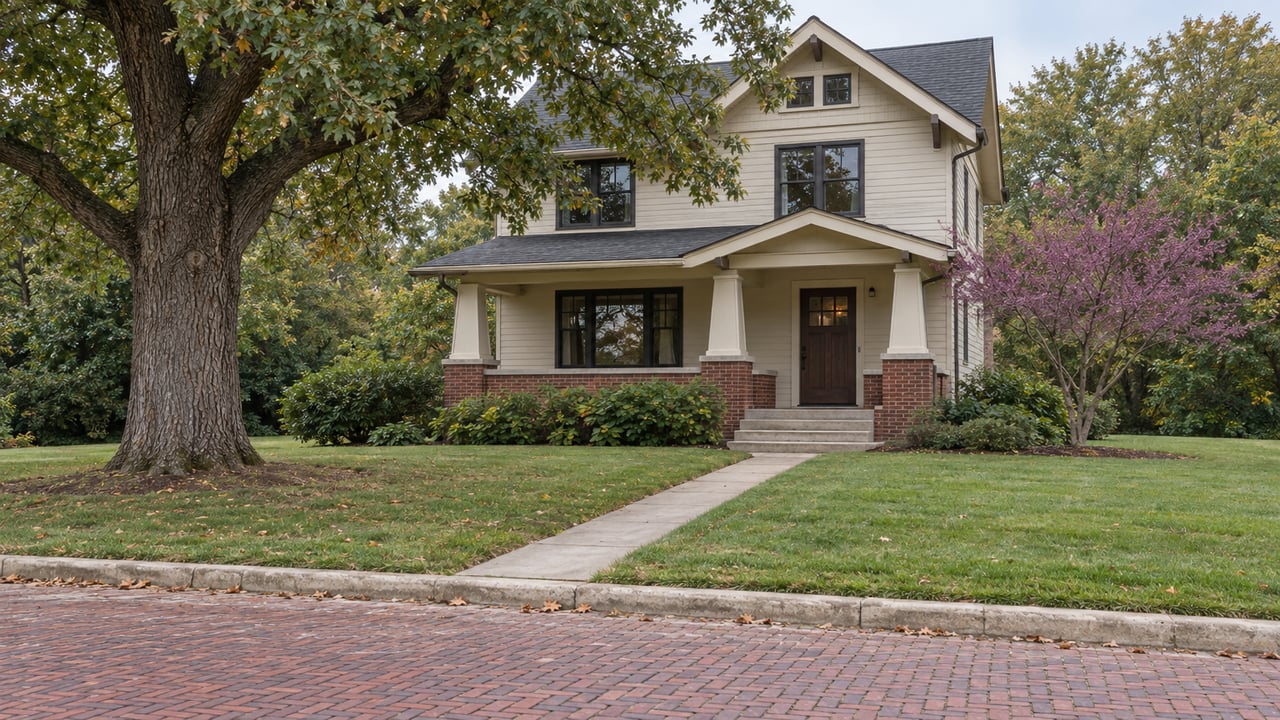
Earlier this year, Baldwin City's council asked residents to weigh in on a leaf motif for a brick street renovation project at the intersection of 8th and High, the kind of small civic decision that only matters to people who actually walk that corner. It's a detail most visitors will never notice. For two days every October, that same corner becomes the center of gravity for a festival that reshapes the town's streets.
Baldwin City counts a little under 5,000 year-round residents, not including the students at Baker University. The Maple Leaf Festival, held the third full weekend of October, pulls in somewhere between 30,000 and 40,000 visitors over a single weekend. That's not just a town hosting an event. That's a town welcoming, over a weekend, a visitor total multiple times its own population, on its own streets, using its own schools, and it does this well enough that most visitors never notice the strain.
The festival's own history explains why the date never moves. Baker University biology professor Dr. Ivan Boyd, working with Dr. Charles Doudna, Bill Horn, Leo Smith, and C.R. Whitley, started the event in 1958 after noticing that the third weekend in October was reliably the peak for the maple leaves changing color in the area. That single observation from a biology professor has held for 68 years, which is longer than most towns manage to keep any tradition tied to a specific weekend.
This year the festival runs October 17 and 18. Over 300 craft and food booths will line 8th and High Street and spill into the local firehouse. A parade kicks off Saturday at 11 a.m., following a children's parade that starts at the library at 10:30. None of that is unusual for a fall festival. What's unusual is the infrastructure built to support it.
Baldwin City doesn't have a parking garage or a fairground lot sized for tens of thousands of cars. It has three schools. Parking and shuttle service run out of the High School, Intermediate Center, and Primary Center lots, all repurposed for the weekend, with buses running visitors into downtown. Some residents rent out yard space near the festival core for a fee, and handicapped parking with placards is held close to the action in designated spots. The parking fees themselves are donation-based and go toward funding local nonprofit organizations, which means the traffic problem the town solves every October also functions as one of its more reliable fundraising mechanisms.
Ask most visitors what Maple Leaf Festival means and they'll describe craft booths and a parade. Ask a longtime resident and quilting tends to come up, because Baldwin City has spent over 50 years building a textile tradition that the festival crowd mostly walks past without realizing what they're looking at.
In 1973, Enola Gish, Helen Erickson, and Helen Gordon started the Maple Leaf Quilt Show, which now stands as the oldest and longest-running quilt show in the state. Four years later, that same group founded the Kaw Valley Quilters Guild, which has since relocated down the road to Lawrence and grown to over 200 active members drawn from northeast Kansas and the greater Kansas City area. Back in Baldwin City, a separate group of local quilters started the Maple Leaf Quilt Guild in 1991, and that guild still calls the town home, organizing quilting events year-round rather than just during festival weekend.
Sharon Vesecky opened Quilters' Paradise, one of the oldest quilt shops in the country, in 1989. She's at least a fourth-generation quilter. Her shop still serves as the drop-off point for quilts entering the festival's show, with entries accepted Wednesday and Thursday before the event at 713 8th Street. This year marks the 54th Annual Quilt Show, running alongside the festival at the Intermediate Center, Saturday from 9 a.m. to 6 p.m. and Sunday from 10 a.m. to 5 p.m.
The show is bigger than one weekend, though. The Lumberyard Arts Center hosts rotating quilt shows and textile art exhibits throughout the year, along with an Open Textile Arts session every Wednesday that has nothing to do with the festival calendar. Baldwin City calls itself the Quilt Capital of Kansas, and the claim holds up mostly because the tradition never actually stops. The festival just happens to be the one weekend a year when outsiders notice it.
Maple Leaf isn't the only reason Baldwin City shuts down its brick streets. Smoke on the Bricks, a Kansas City Barbecue Society sanctioned competition, brings barbecue teams downtown each August to compete for a total purse of $10,000 across categories including chicken, ribs, pork, and brisket. This year's competition ran August 7 and 8, and it doubles as a qualifying event for both the American Royal World Series of Barbecue and the Jack Daniels World Championship. Friday evening turns into a public tasting event called Taste of Baldwin City, where the general public buys BBQ Bucks from the Baldwin City Recreation Commission and trades them for samples from competing teams, with proceeds split between the teams themselves and the Baldwin Education Foundation.
Earlier in the year, Thunder on the Bricks brings antique and classic cars to the same brick streets for a one-day car show each May. Between the car show, the barbecue competition, and Maple Leaf weekend, downtown Baldwin City closes to through traffic on a predictable rhythm several times a year, not because the town struggles with planning but because its downtown core is small enough and walkable enough that closing it works better than trying to route festival crowds around moving traffic.
That rhythm is also why a decision as small as a leaf motif for the brick renovation at 8th and High became something the city council put to residents rather than deciding on its own. A street that hosts a parade route and thousands of pedestrian feet every October is worth getting right.
Maple Leaf weekend also includes free historic bus tours, and one of the stops is the Black Jack Cabin, located in the roadside park at 2011 North 200th Road along Highway 56. The cabin sits at Black Jack Battlefield and Nature Park, a site tied to the Battle of Black Jack, one of the events historians consider a direct precursor to the Civil War during the Bleeding Kansas period. Baldwin City and Douglas County jointly acquired the site, recognizing it as nationally significant. During the festival, the cabin is open Saturday from 9 a.m. to 4 p.m., a narrow window for a piece of history that most of the craft-booth crowd never seeks out on its own.
The same pattern shows up with the old city power plant on High Street, open during festival hours from 10 a.m. to 2 p.m., another building most visitors walk past without a second look. Baldwin City treats its own history the way it treats its quilting tradition: present year-round, but only visible to outsiders during the one weekend a year when the town puts it on display.
None of this is really about the festival. It's about what a small Kansas town can do with the infrastructure it already has. Three public schools double as parking lots. A recreation commission runs a barbecue competition with a five-figure purse using volunteer labor. A quilt shop that's been open since 1989 still serves as the town's unofficial festival headquarters. A battlefield with genuine national significance gets a few open hours a year because that's what the calendar allows.
Baldwin City doesn't build new capacity for Maple Leaf Festival weekend. It repurposes what it already has, three times a year for three different events, and the same brick streets that host a car show in May and a barbecue competition in August welcome a total weekend visitor count six to eight times the town's population in October. That's not a coincidence of good timing. It's a town that has figured out, over decades, how to put its existing downtown to work for a festival of that scale.
If you're already living near that stretch of 8th and High, or thinking about what it means to call a town like Baldwin City home, Sandra Zepeda would be glad to talk through what makes this corner of Douglas County work the way it does. Let's Connect.
Whether you are purchasing your first home, selling a property, or preparing for your next move, I take the time to explain the process, answer your questions, and help you make informed decisions about one of life’s most important investments. My goal is to become your trusted real estate advisor, exceed your expectations, and build a relationship that continues long after closing. I look forward to meeting you and helping turn your real estate dreams into reality.
Sandra Zepeda
BETTER HOMES AND GARDENS REAL ESTATE WOSTAL REALTY
(785) 220-9079
[email protected]
BROKERAGE OFFICE NUMBER: (785) 367-4747
2901 SW BURLINGAME RD TOPEKA, KS 66611