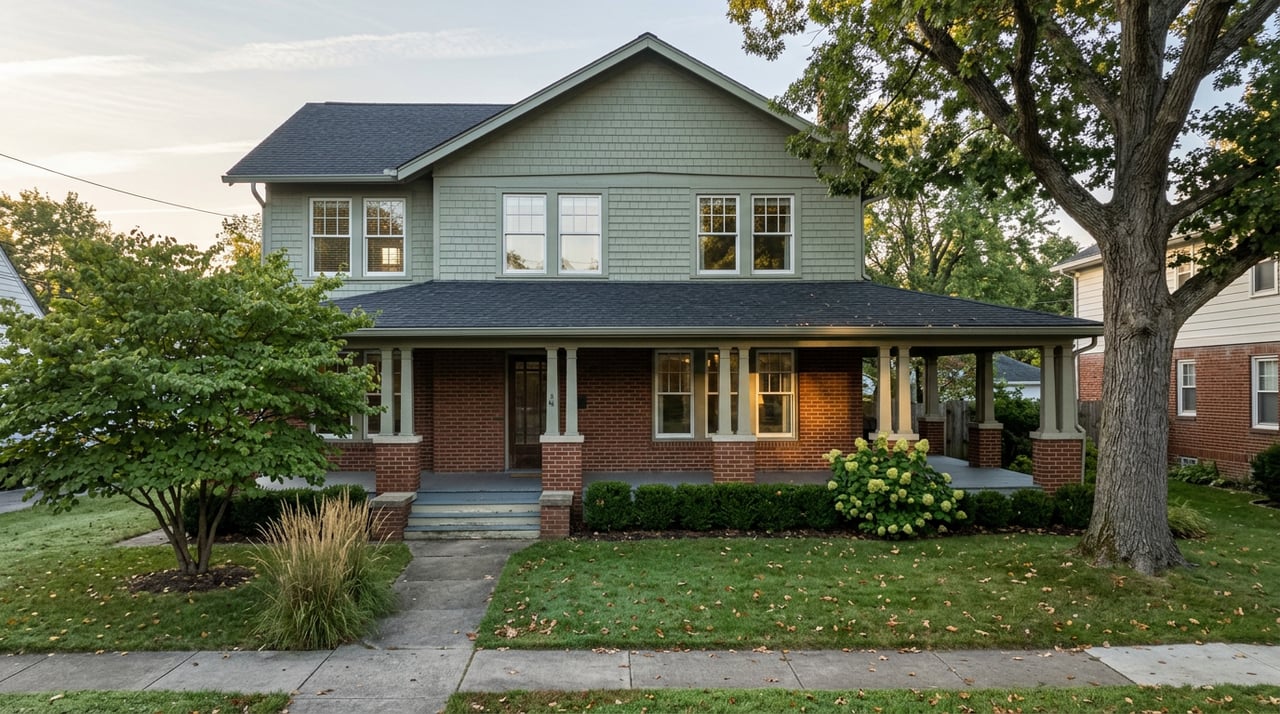
The 250 Feet Around a Lawrence Landmark Aren't Governed by a Rulebook. They're Governed by a Vote.
September 10, 2026
September 10, 2026
Ask most people what it means to buy near a historic district in Lawrence, and they'll tell you about paint colors and window replacements. That's the version everyone already knows. What they don't know is that the actual standard the city uses to approve or deny your project isn't a checklist at all. It's a judgment call made by a small commission, using language soft enough that the commissioners themselves have publicly wondered whether it's too vague to apply fairly.
That's not a criticism from the outside. It's a quote from inside a Lawrence City Commission meeting this spring, where the Historic Resources Commission's own chair and vice chair sat down with city commissioners to talk through how the review process actually works. One commissioner asked whether the criteria were even clear enough to follow consistently. The vice chair's answer was blunt:
"It doesn't say you can't have pink siding."
In other words: there's no forbidden list. There's a feeling the commission is trying to protect, and feelings don't fit neatly into permit applications.
Lawrence's local historic districts include Old West Lawrence, Oread, Pinckney I and II, Hancock, Breezedale, and North and South Rhode Island, along with a separate Downtown Historic District covering the commercial core along Massachusetts Street and the East Lawrence Industrial District. Full maps for each are public on the city's historic resources page.
But being inside one of those boundary lines isn't the only way to get pulled into review. Lawrence also enforces what it calls an "environs" or context area: a 250-foot radius around any individually designated landmark or historic property. Buy a house two blocks from a district boundary but within that radius of a single landmarked home, and your exterior renovation can still trigger a review you never expected. This is the detail generic guides skip, because it means the relevant question isn't "am I in a historic district" but "am I within 250 feet of something that is."
Once you're in scope, the city sorts your project into one of two tracks, and the difference matters for anyone with a renovation timeline.
| Review Path | Who Decides | How It Moves | What Qualifies |
|---|---|---|---|
| Minor | Historic Resources Administrator (staff) | Handled administratively, no hearing required | Repair or replacement using materials identical to what's already there |
| Major | Full Historic Resources Commission | Monthly public hearing, generally the third Thursday, City Commission Room at City Hall | New materials, additions, or anything that changes the building's appearance |
A Certificate of Approval, sometimes called a Certificate of Appropriateness depending on which review track applies, is required before any exterior construction, alteration, demolition, or removal on a designated landmark, a property inside a historic district, or a property in that 250-foot environs. The commission evaluates major projects against the Secretary of the Interior's Standards and Guidelines for Rehabilitation, which sounds precise until you watch it applied in practice.
Public meeting records make the inconsistency visible. In April 2025, an addition at 2207 Barker Avenue sailed through with a unanimous 4-0 vote. A 2022 case at 620 Indiana Street for new additions cleared both state law review and a Certificate of Appropriateness without apparent friction. But a proposed demolition and new construction at 943 Louisiana Street, reviewed under state law, a Certificate of Appropriateness, and the Oread Neighborhood Design Guidelines, was pulled from the agenda entirely, deferred by the applicant rather than argued in front of the commission. Same city, same commission, same general framework, three very different paths.
If you're a buyer eyeing a fixer-upper near one of these districts, that variability is the actual thing to plan around. Two nearly identical additions can land in different places depending on how the project is presented, what precedent the commission is weighing that month, and who's in the room.
There's real financial upside to doing this the right way. Owners of properties listed on the State or National Register, or contributing properties within a historic district, can qualify for a 20 percent federal income tax credit on qualified rehab expenses for income-producing property, and a 25 percent state tax credit that applies to both income and non-income producing properties. Projects need to total at least $5,000, though the Lawrence Preservation Alliance notes that two smaller projects, like a new roof paired with exterior paint, can be combined to clear that minimum. The catch: your project has to be approved by the state's Cultural Resources office before you start work, and you'll need to photo-document the process to verify completion.
The downside is just as real. Skip the approval and do the work anyway, and you're exposed to civil fines up to $25,000 under the State Historic Preservation Act, according to the city's own historic resources page. That's not a hypothetical number pulled from statute for flavor. It's the number the city cites to homeowners directly.
Here's the part that makes timing matter more than most real estate guides admit: the 250-foot environs rule isn't settled policy. It's actively contested.
In 2024, the city already narrowed it once, shifting many smaller projects within that radius from a full HRC hearing to staff-level administrative approval. Then this spring, city commissioners sat down with HRC chair Brenna Buchanan and vice chair Joy Coleman specifically to ask whether the rule should exist at all. Commissioner Amber Sellers asked whether Kansas law even required it. Buchanan's answer was that the state used to require it but now leaves the choice to individual cities, and fellow commissioner Brad Finkeldei added that Lawrence is one of the few Kansas cities that still has one. Some commissioners raised concern that the context area could be slowing development in the city's denser neighborhoods.
That conversation, reported by the Lawrence Journal-World, didn't end in a vote to change anything on the spot, and no final rule change had followed as of this writing. But it tells you something concrete: the rule that governed the house next door in 2023 may not be the rule that governs your own permit application a year from now. If you're buying near a landmark with renovation plans already in mind, that uncertainty belongs in your timeline, not as a footnote.
If you're under contract on a property in or near one of Lawrence's historic districts, a few things are worth doing before you finalize plans:
Does a property have to be inside a historic district to be affected by these rules? No. The 250-foot environs around an individually designated landmark can trigger review even for a property outside any district boundary.
What happens if a previous owner did unapproved exterior work? The compliance issue attaches to the property, not the person who did the work, which is why asking about permit and approval history before closing matters.
Is there a way around the Certificate of Approval process if it creates a real financial burden? Owners can apply for a Certificate of Economic Hardship as an alternative, and the commission has 45 days to determine whether denying a standard approval would deprive the owner of reasonable use of the property.
Are the district boundaries themselves likely to change? The boundaries of Lawrence's local historic districts aren't part of the current debate. What's under discussion is the 250-foot environs rule around individual landmarks outside those boundaries.
If you're weighing a purchase near Old West Lawrence, Oread, or any of Lawrence's other historic districts, and you want to know exactly what a specific address is subject to before you write an offer, I'd rather walk through it with you now than have it surprise you at closing. Reach out to Sandra Zepeda and let's connect.
Whether you are purchasing your first home, selling a property, or preparing for your next move, I take the time to explain the process, answer your questions, and help you make informed decisions about one of life’s most important investments. My goal is to become your trusted real estate advisor, exceed your expectations, and build a relationship that continues long after closing. I look forward to meeting you and helping turn your real estate dreams into reality.
Sandra Zepeda
BETTER HOMES AND GARDENS REAL ESTATE WOSTAL REALTY
(785) 220-9079
[email protected]
BROKERAGE OFFICE NUMBER: (785) 367-4747
2901 SW BURLINGAME RD TOPEKA, KS 66611